
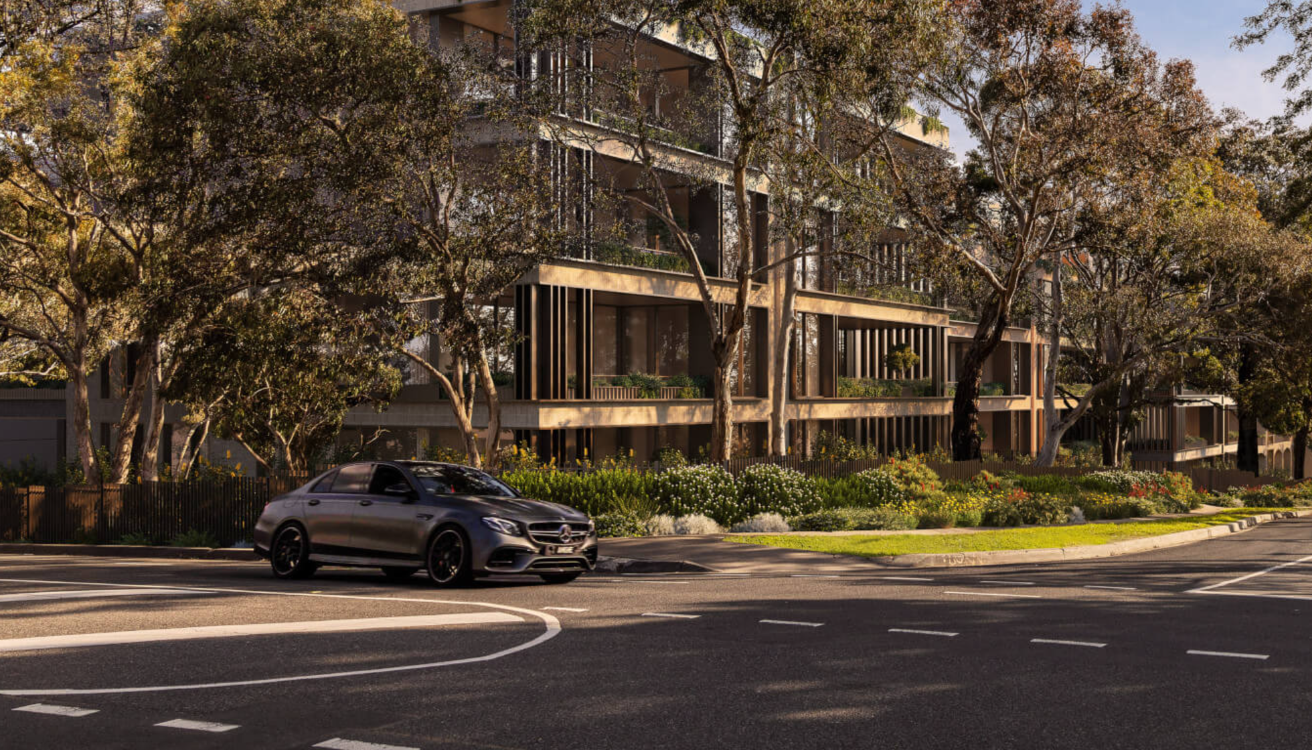
AMENDMENT VC300 INTRODUCES NEW CODE FOR HOUSING APPLICATIONS
Today marks another important day for housing in Victoria: the introduction of the Mid-Rise Code into the planning scheme via Amendment VC300. As part of the planning reforms promised in 2023, Amendment VC300 is aimed at improving feasibility, certainty and approval timeframes for medium‑density housing, by introducing ‘deemed to comply’ standards for mid-rise residential development. We unpacked these new planning changes, while reflecting on the real-world effect that a similar reform has had on the housing crisis.
What is Amendment VC300 and why has it been introduced?
It’s a significant change in planning schemes across Victoria, transforming the ‘4 Storey Apartment Standards’ into the ‘Mid-Rise Code’. The new Mid-Rise Code applies to residential developments of 4 to 6 storeys in the following zones: Residential Growth Zone (RGZ), Housing Choice and Transport Zone (HCTZ), Mixed Use Zone (MUZ), and Township Zone (TZ) (where land is within the Urban Growth Boundary in metropolitan Melbourne).
The code (or Clause 57) no longer applies in the General Residential Zone (GRZ) or the Neighbourhood Residential Zone (NRZ).
Clause 57 introduces clear, measurable standards for mid‑rise housing and sets out when a proposal can be assessed as ‘deemed to comply’, significantly narrowing the scope of planning assessment, supporting the objectives of the State Government’s Victoria’s Housing Statement: The Decade Ahead 2024–2034.
So, how do ‘codified’ standards work?
Clause 57 introduces a ‘deemed to comply’ assessment type, as we’ve seen in Clause 55. Under the deemed to comply pathway:
- All Clause 57 objectives must be met
- Where a standard is met, the objective is taken to be met
- Decision guidelines apply only where a standard is not met, and an alternative design solution is proposed to meet the objective.
Further, certain policy and decision guidelines (that decision-makers were previously required to consider) are switched off, with the intention being to facilitate development in line with Clause 57.
Existing third-party notice requirements continue to apply. However, objectors cannot seek review at VCAT where all the applicable standards under Clauses 57.02 (Urban context) and 57.04 (External amenity) are met – so developers aren’t tangled up in objector appeals if they’ve met the relevant standards, and compliant housing can be approved faster.
What standards have changed?
Amendment VC300 makes changes to the standards in Clause 57. Some of the changes include revised street setbacks, new building separation and light court standards, updated private open space requirements and revised tree canopy controls. Several standards have also been removed, including building height, dwelling diversity and solar access controls. We’ve put together a table at the bottom of the page for a more detailed breakdown of the changes.
What about overlays?
When a site is also affected by an overlay (such as a Heritage Overlay), the requirements of the overlay still apply, including notice and review rights for objectors as relevant to the overlay only. However, one critical change of VC300 is that the Neighbourhood Character Overlay can no longer be used to vary Clause 57 standards. As the housing crisis is hitting hard, a shift towards technical compliance (rather than design opinion) has become a priority over stringently preserving the look of a neighbourhood.
That’s not to say development can be careless. While the purpose of Amendment VC300 is to encourage increased housing development, it also aims to protect the amenity of what’s around those developments – helping avoid any unreasonable impacts on existing homes.
Are there changes for mid-rise applications in other residential zones?
For applications in the General Residential Zone and Neighbourhood Residential Zone, Clause 57 does not apply. However, we’ve been told that the Department of Transport and Planning will review these zones later in the year, amending the decision guidelines of these zones to reference the new Clause 57.
When does all this come into effect? What about existing applications?
Amendment VC300 applies to applications lodged from 16 April 2026. Transitional provisions apply to earlier applications, which means that amendments to applications lodged before this date will continue to be assessed by the previous version of Clause 57, and don’t benefit from the new ‘deemed to comply’ standards. But transitional provisions are complicated, and amending a current application may mean that the new Clause 57 applies – so we recommend getting in touch with your UPco planner to advise on your particular situation.
Lastly, do you think the new Clause 57 will actually help move the needle on housing development?
Since Clause 55 was codified, we’ve started to see small improvements in things like willingness to apply and approval rates compared with the year before. This is backed by statewide data that broadly shows numbers of multi-dwelling residential applications and approvals nudging upwards, while appeals are dropping significantly.[1] While we’re only one small piece of the puzzle, we’re hoping that adding Clause 57 to the mix of residential codes will keep pushing positive trends as we see greater feasibility in medium density housing.

We’re always happy to help guide our development partners through planning changes – big or small. If you’re wondering what this could mean for your current or future housing projects, we’d love to chat. Drop us a line on info@upco.com.au
Table of changes in Clause 57
| Standard | Change |
| URBAN CONTEXT | |
| E2-1 Street setback | Reduce front setback to 4.5 metres from a front street and 3 metres to a side street. New objective to provide space for canopy trees. |
| Building height | Deleted |
| E2-2 Side and rear setbacks | The ability to choose from two side and rear setbacks options: existing “B17” side and rear setback standard or a new side and rear setback standard. The new standard requires a minimum setback of 4.5 metres for the full height of the building, except for side and rear setback to a southern boundary which requires a minimum setback of 6 metres for a building height of 11 metres, and 9 metres for a building height over 11 metres. |
| E2-3 Walls on boundaries | No change |
| E2-4 Site coverage | 70 per cent, unless specified otherwise in the schedule to the zone |
| E2-5 Access | No change |
| E2-6 Tree canopy | Basements setback at least 3 metres from the street frontage and at least one other boundary. |
| E2-7 Front fences | Introduced a minimum transparency of 25 per cent. |
| LIVEABILITY | |
| E3-1 Parking location | No change |
| E3-2 Street integration | Limited change with same metrics. |
| E3-3 Building entry and circulations | External covered area over the entry door to the building of at least 1.44 metres at a minimum dimension of 1.2 metres.Shared corridors and common areas to have natural light and natural ventilation. A clear sightline from the building entry to the lift lobby at ground floor. |
| E3-4 Private open space | No change to the minimum area requirements. New maximum length of 3 metres (parallel to the external wall) for all balconies. |
| E3-5 Communal space | New standard. Communal open space required for all developments of 10 or more dwellings, at a rate of 2.5 square metres per dwelling or 25 per cent of the site area, whichever is the lesser. This may consist of multiple separate areas of communal space. If outdoor communal space is provided, 50 percent of the area or 25 square metres, whichever is greater, is not overshadowed for a minimum of 2 hours between 9am and 3pm on 22 September. |
| E3-6 Functional layout | No change |
| E3-7 Room depth | Limited change with same metrics. |
| E3-8 Daylight to new windows | Removed some of the metrics, intent remains. |
| E3-9 Natural ventilation | Breeze path metrics the same but reduced to 40 cent of all dwellings. |
| E3-10 Storage | No change |
| E3-11 Accessibility | No change |
| E3-12 Building separation within a site | New standard requires walls of buildings with habitable room windows or balconies are set back from other buildings on the same site by 9 metres. |
| E3-13 Light courts | New standard requires light courts metrics: A minimum dimension of at least 4.5 metres and area of at least 20.25 square metres A minimum dimension of at least 6.0 metres and area of at least 36 square metresEnclosed by the wall of a building for at least 75 per cent of its permitter Is not the primary source of daylight to a living room of private open space. |
| EXTERNAL AMENITY | |
| Daylight to existing windows | Deleted |
| Existing north facing windows | Deleted |
| E4-1 Overshadowing secluded private open space | This standard does not apply to any part of a new building that meets the Side and Rear Setbacks (E2-2) and walls on boundary (E2-3) standards. |
| E4-2 Overlooking | Sill heights reduced from 1.7 to 1.7 metres.This standard does not apply to a new habitable room windows, balcony, or terrace that is located in part of a building that meets Side and Rear Setbacks (E2-2). |
| Internal views | Deleted |
| SUSTAINABILITY | |
| E5-1 Permeability and stormwater management | Limited change with same metrics. |
| Overshadowing domestic solar energy systems | Deleted |
| Rooftop solar energy generation area | Deleted |
| Solar access protection to new north facing windows | Deleted |
| E5-2 Waste and recycling | Removes distinction between Dwelling and Apartment development. |
| E5-3 Noise impacts | Introduced the same standard as at Clause 58 |
| E5-4 Energy efficiency | No change |
[1] PPAR data for new multi-dwelling applications in residential zones across Victoria (1 July 2024-28 February 2025 before the introduction of the Townhouse and Low-Rise Code compared with 1 July 2025-28 February 2026 for the equivalent period after the introduction of the Townhouse and Low-Rise Code)
Cover image courtesy of Hamton Property